STAX Generational Trends: The Gen X Factor

Older generations spearheaded a stock-buying spree in February, even as the S&P 500® Index (SPX) failed to reclaim its highs and concerns grew over AI's potential to disrupt major industries.
The Schwab Trading Activity Index™ (STAX)—which analyzes Schwab client stock positions and trading activity to gauge investor sentiment—rose nearly 15% month over month to 57.32 in February.
"While markets wobbled, Schwab clients leaned into volatility, selectively buying quality at perceived discounted prices, particularly in tech and AI-exposed names, signaling confidence in earnings and fundamentals over fear-driven narratives," said Joe Mazzola, head trading and derivatives strategist at Schwab. "Buying was early, deliberate, and tied to volatility. This pattern has continued for the past six months, suggesting this is not a one-off reaction but a persistent behavioral trend."
Gen X investors, born between 1965 and 1980, led the charge over the proverbial wall of worry. While Gen X has consistently posted the highest STAX score among all generations since Schwab began tracking generational data in June 2024, their February STAX score of 65.71 marked a record high.
The Silent Generation (born before 1946) and Baby Boomers (born between 1946 and 1964) were also bullish, posting STAX scores of 56.02 and 57.75, respectively. On a month-over-month basis, the Silent Generation's STAX score rose the most, surging 16.8%, while Baby Boomers' rose 15.7% and Gen X's jumped 14.5%.
Older generations were bullish last month despite increased geopolitical tensions and signs of economic strain, including weak gross domestic product (GDP) and retail sales data. They also generally looked past AI's potential to disrupt traditional business models even as disruption-related fears contributed to double-digit declines in shares of some companies viewed as particularly vulnerable.
"Many of these investors have lived and eventually profited through market downturns tied to the dot-com and global financial crisis bear markets. Staying the course and looking for oversold opportunities has been a hallmark of their investing strategies," said Mazzola.
Millennials (born between 1981 and 1996) were also optimistic about the market, although slightly less bullish than older generations. Their STAX score rose 13% month over month to 55.71.
Gen Z and Gen Alpha remained more cautious.
Gen Z's STAX score rose 10.6% month over month to 45.36, while Gen Alpha's score rose 12.4% to 45.36. Younger generations have been coping with higher unemployment rates amid a labor market slowdown, which may have played into their more bearish sentiment in February. The U.S. unemployment rate for those aged 16 to 24 rose to 9.5% in February, according to the Bureau of Labor Statistics, compared to just 4.2% for the prime-age workforce (ages 25 to 54) and 3.3% for individuals 55 and older.
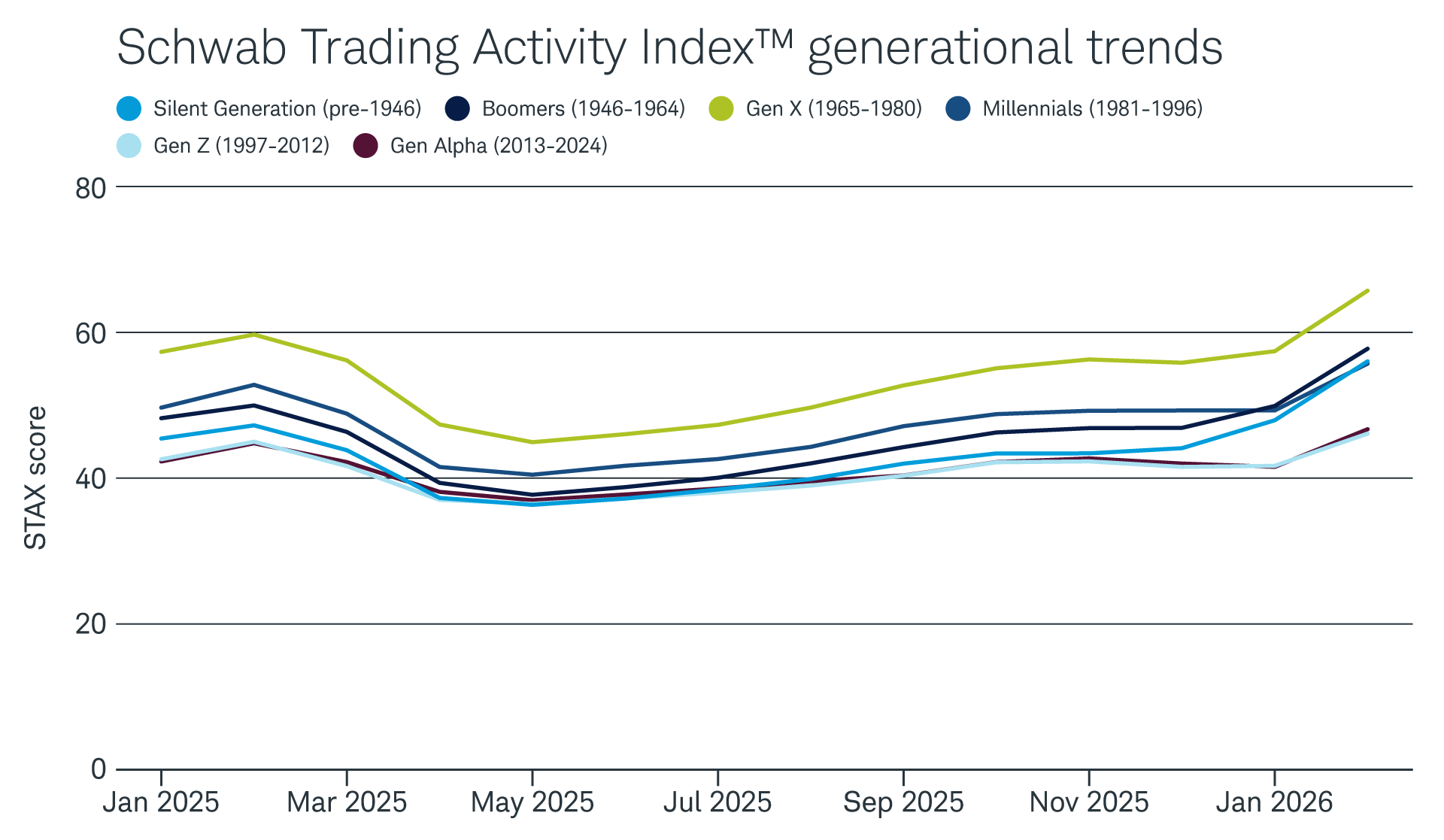
Source: Schwab
For illustrative purposes only.
STAX reports on what traders are actually doing with their money, not just what they say they're doing. Want to dig deeper into the latest retail investor trading activity? Check out February's STAX report.